Ops was the Roman goddess of plenty, harvests and the wealth of the earth. The wife of Saturn, she was identified by the Romans with the Greek Rhea, mother of the Olympian gods, and later with Cybele, the Great Mother worshipped in Asia Minor. Her name means “abundance” or “resources” in Latin, and it survives in English words such as “opulent”.
Ops at a Glance
- Domain: abundance, harvest and the fertile earth
- Husband: Saturn
- Greek counterpart: Rhea; also identified with Cybele
- Festivals: the Opiconsivia (August 25) and the Opalia (December 19)
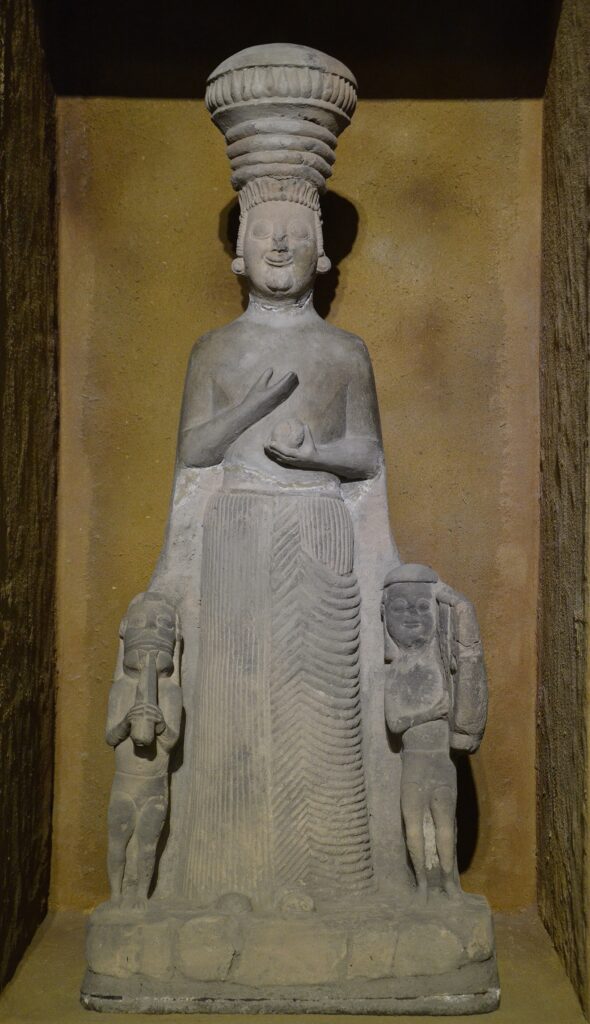
The account below is reproduced from a classic public-domain book, as it appeared on the original A World of Myths site. Spelling of some names follows the original.
Cybele, the Great Mother
Cybele, or Vesta the elder. It is highly necessary, in tracing the genealogy of the heathen deities, to distinguish between this goddess and Vesta the younger, her daughter, because the poets have been faulty in confounding them, and ascribing the attributes and actions of the one to the other. The elder Vesta, or Cybĕle, was daughter of Caelus and Terra, and wife of her brother Saturn, to whom she bore a numerous offspring. She had a variety of names besides that of Cybĕle, under which she is most generally known, and which she obtained from Mount Cybĕlus, in Phrygia, where sacrifices to her were first instituted. Her sacrifices and festivals, like those of Bacchus, were celebrated with a confused noise of timbrels, pipes, and cymbals; the sacrificants howling as if mad, and profaning both the temple of the goddess, and the ears of their hearers with the most obscene language and abominable gestures.
Under the character of Vesta, she is generally represented upon ancient coins in a sitting posture, with a lighted torch in one hand, and a sphere or drum in the other. As Cybĕle, she makes a more magnificent appearance, being seated in a lofty chariot drawn by lions, crowned with towers, and bearing in her hand a key. Being goddess, not of cities only, but of all things which the earth sustains, she was crowned with turrets, whilst the key implies not only her custody of cities, but also that in winter the earth locks those treasures up, which she brings forth and dispenses in summer: she rides in a chariot, because (fancifully) the earth hangs suspended in the air, balanced and poised by its own weight; and that the chariot is supported by wheels, because the earth is a voluble body and turns round. Her being drawn by lions, may imply that nothing is too fierce and intractable for a motherly piety and tenderness to tame and subdue. Her garments are painted with divers colors, but chiefly green, and figured with the images of several creatures, because such a dress is suitable to the variegated and more prevalent appearance of the earth.
Source: Charles K. Dillaway, Roman Antiquities, and Ancient Mythology. Public domain.
Ops
In Rome the Greek Rhea was identified with Ops, the goddess of plenty, the wife of Saturn, who had a variety of appellations. She was called Magna-Mater, Mater-Deorum, Berecynthia-Idea, and also Dindymene. This latter title she acquired from three high mountains in Phrygia, whence she was brought to Rome as Cybele during the second Punic war, B.C. 205, in obedience to an injunction contained in the Sybilline books. She was represented as a matron crowned with towers, seated in a chariot drawn by lions.
Source: E. M. Berens, Myths and Legends of Ancient Greece and Rome (1880). Public domain.
Recent Comments