The Minotaur
The bull-headed prisoner of the Labyrinth. He had a real name, nobody agrees how he died, and no ancient artist ever gave him an axe.
THE QUICK ANSWER
What the internet gets wrong
“The Minotaur fought with a huge double axe.”
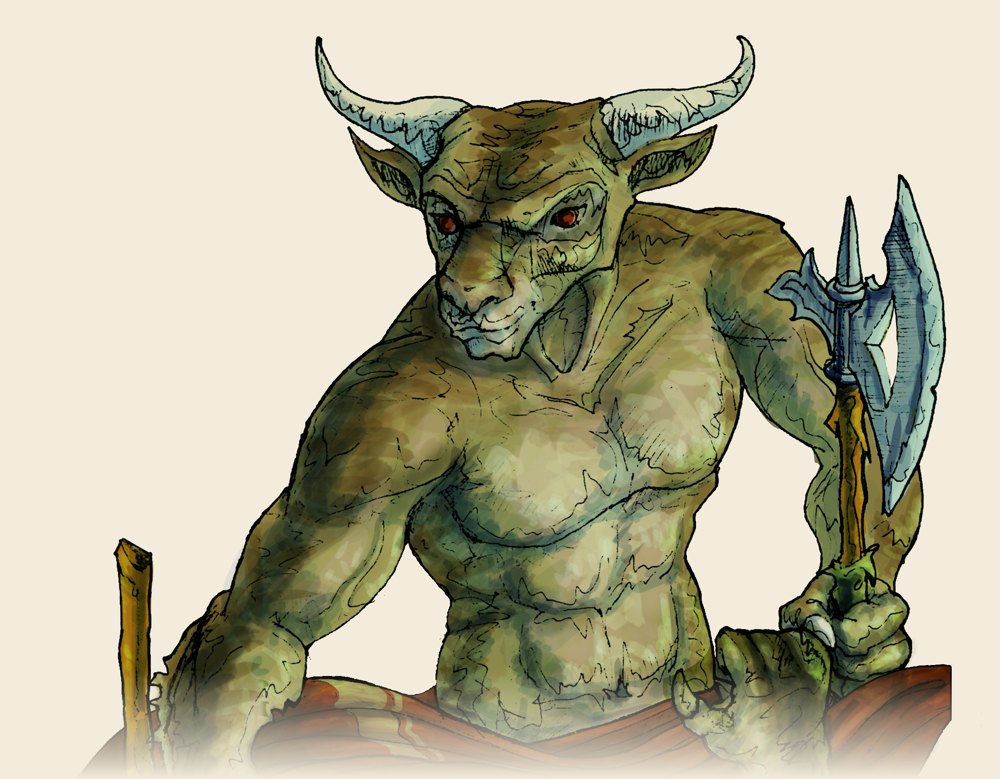
No ancient text or image arms him with an axe. On Greek vases and on the coins of Knossos he fights barehanded or with a rock in his fist. The double axe was a sacred symbol at Knossos, and modern artists handed it to him.
“Homer tells the story of the Minotaur.”
Homer mentions Minos, Ariadne, Theseus and a dancing floor Daedalus built at Knossos. He never mentions a monster or a maze.
“His name was the Minotaur.”
Minotaur is a label that means “bull of Minos.” The name his mother gave him was Asterion, or Asterios, “the starry one,” after the old king of Crete who raised Minos.
THE SOURCE
“Theseus killed him with a sword.”
Early vase painters give Theseus a sword. Later ones give him a club. Apollodorus says he used his fists. One carved throne in Sparta showed him leading the Minotaur out tied up and alive.
THE SOURCE
“The Labyrinth was a maze full of dead ends.”
Ancient writers describe exactly that, which is why Theseus needs a thread. Ancient artists drew something else: one long winding path with no choices at all. Both versions are ancient.
“The palace at Knossos was the real Labyrinth.”
Arthur Evans argued this after he began digging there in 1900. A clay tablet from Knossos does record a gift of honey to the “Mistress of the Labyrinth,” so the name was real in the Bronze Age. Whether it meant the palace is still argued.
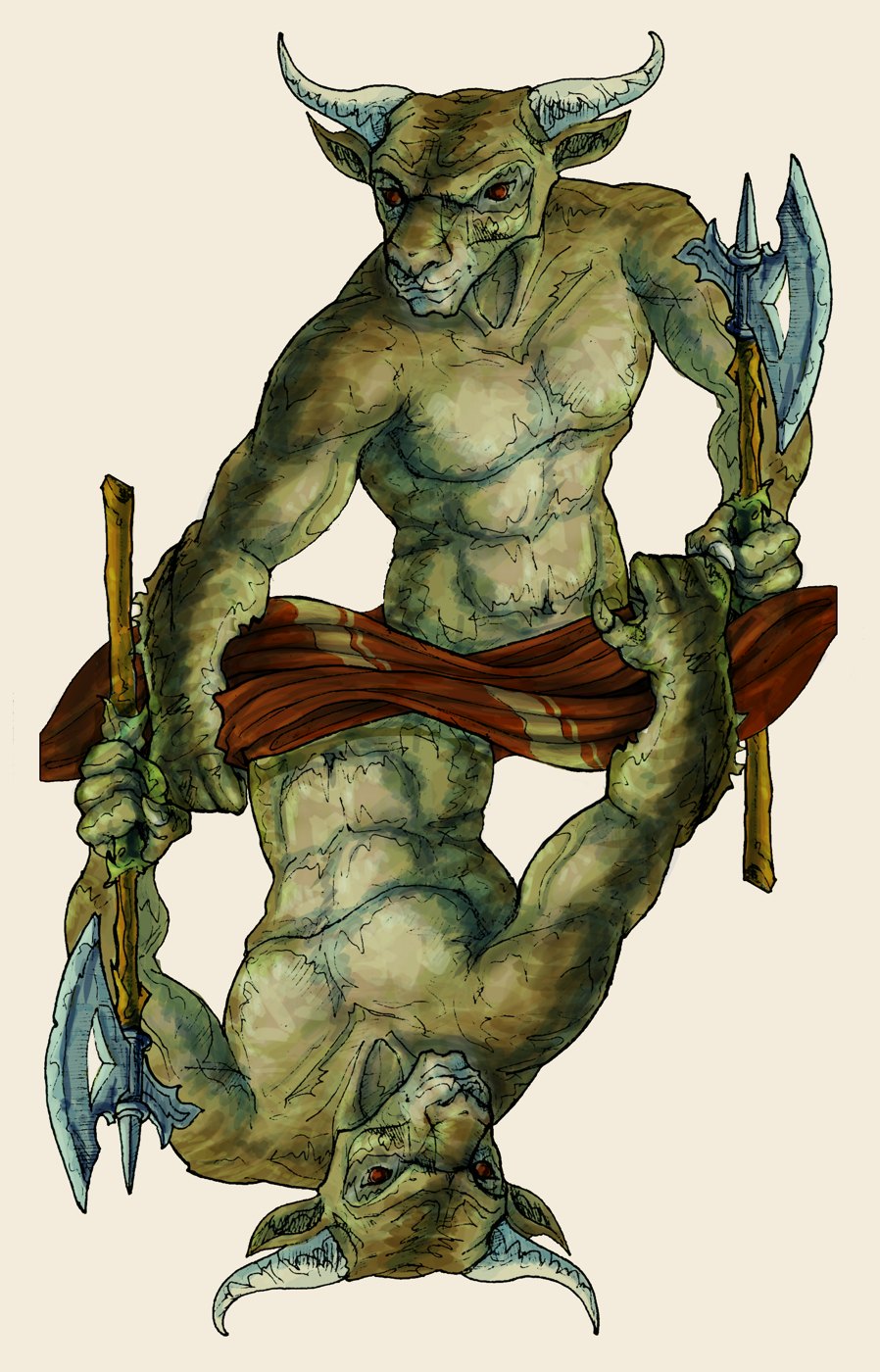
Jack of Spades
The Minotaur is the Jack of Spades in the Mythical Creatures deck from Gent Supply Co. Spades are the Greek suit, where he sits beside Typhon, Medusa and the Hydra. Illustration by Mexico City artist Gustavo “Guzo” Borboa.
We checked our own card too. The horns, the bull’s head and the human body come straight from the ancient art. The axes are the artist’s own touch, a nod to the double axes carved into the walls at Knossos.
The full story
The Minotaur is one of the most famous monsters in Greek myth and one of the least described. No single ancient author tells his whole story. It has to be pieced together from poets, playwrights, travel writers and painted pots, and they do not always agree. Here is how the pieces fit.
1. It starts with a broken promise
Minos wanted to be king of Crete. To prove the gods were on his side, he prayed to Poseidon to send a bull out of the sea and promised to sacrifice it. The bull came, and it was so fine that Minos kept it and killed a lesser animal in its place.
Poseidon took his revenge on the household. He made Minos’s wife, Pasiphae, fall helplessly in love with the bull. The inventor Daedalus built her a hollow wooden cow so she could get near it. The child she bore had the face of a bull and the body of a man. A later Roman handbook blames the goddess Venus for the curse instead of Poseidon.
2. His mother gets her say
The Athenian playwright Euripides wrote a tragedy about this called The Cretans. Only fragments survive, but one of them is Pasiphae’s speech in her own defense. She argues that no woman would choose such a thing, that a god drove her mad, and that the real guilt belongs to Minos for cheating Poseidon. It is the closest the ancient world comes to taking her side.
3. A prison, and a price
Minos could not kill the child and could not bear to look at him. He had Daedalus build the Labyrinth, a building so tangled that nothing put inside could find the way out, and shut Asterion in it.
Around the same time Minos’s son Androgeos died in Athens. Minos went to war over it and won. His terms were seven young men and seven young women, sent to Crete and fed to the Minotaur. Plutarch says the ships sailed every nine years. Other writers make it every year.
4. Theseus, a thread and a glowing crown
Theseus, the prince of Athens, volunteered to go as one of the fourteen. Minos’s daughter Ariadne fell in love with him and gave him a ball of thread to tie at the entrance and unwind as he walked in. In the earliest version we have, the thread was Daedalus’s idea.
There is an older or rival version with no thread at all. In that one Ariadne gives Theseus a crown of gold and jewels that glows in the dark, and he finds his way by its light. The gods later set the crown in the sky as the constellation Corona Borealis.
5. How he dies depends on who is telling it
Vase painters in Athens loved this scene and painted it hundreds of times. On the early pots Theseus grabs the Minotaur by a horn and runs him through with a sword, while the Minotaur sinks to one knee with a rock in his hand. Later painters swap the sword for a club. Apollodorus has Theseus find him in the deepest part of the Labyrinth and beat him to death with his fists.
The strangest version was carved on a throne at Amyclae, near Sparta. The travel writer Pausanias saw it and reports that Theseus was leading the Minotaur out bound and alive. Nobody knows what story went with it.
6. Artists knew what he looked like before writers did
The oldest pictures of a bull-headed man fighting a hero date to the 600s BCE. The oldest surviving descriptions in words are about two centuries younger. In all that time the artists never wavered: a man’s body, a bull’s head, sometimes a tail.
Writers were vaguer. The Roman poet Ovid never uses the word Minotaur in his long telling of the story, and elsewhere he calls the creature only “a man half bull and a bull half man.” Meanwhile the city of Knossos put him on its silver coins, running with a stone in his hand, with a maze on the other side. Some early coins have a star at the center of the maze, which may be a nod to the name Asterion.
7. Some Greeks did not believe a word of it
By the 300s BCE there were writers who thought the whole thing was a garbled memory. Palaephatus said “Tauros,” which means bull, was just the name of a handsome man at court whom the queen loved. The historian Philochorus reported what the Cretans themselves said: the Labyrinth was an ordinary prison, and Tauros was a bullying general whom Theseus beat in a wrestling match. Plutarch collects these versions side by side with the monster story and lets the reader choose.
8. What was really at Knossos
The Romans said no trace of the Labyrinth was left. Then in 1900 Arthur Evans began to dig at Knossos and found a huge Bronze Age building with hundreds of rooms, wall paintings of young people vaulting over bulls, and double axes carved on its stone blocks. He decided he had found the Labyrinth.
The tablets found there complicate the picture. One records a jar of honey for “the Mistress of the Labyrinth,” written around 1400 BCE, long before any Greek told the story of Theseus. So the Labyrinth was a real name for a real holy place, and it belonged to a goddess. The monster arrived later. The bull that started it all has its own afterlife: it is the Cretan Bull that Heracles was sent to capture.
SOURCES WE CHECKED
- Homer, Iliad 18.590–592 and Odyssey 11.321–325
- Bacchylides, Ode 17
- Pherecydes of Athens, fragment 148 (Fowler)
- Euripides, The Cretans, fragment 472e
- Palaephatus, On Unbelievable Tales 2
- Diodorus Siculus, Library of History 4.77
- Ovid, Metamorphoses 8.152–176 and Ars Amatoria 2.24
- Pliny the Elder, Natural History 36.84–90
- Plutarch, Life of Theseus 15–19
- Apollodorus, Library 3.1.3–4 and Epitome 1.7–9
- Pausanias, Description of Greece 2.31.1 and 3.18.11
- Hyginus, Fabulae 40 and De Astronomia 2.5
- Timothy Gantz, Early Greek Myth: A Guide to Literary and Artistic Sources (Johns Hopkins University Press, 1993)
- Robert L. Fowler, Early Greek Mythography (Oxford University Press, 2000 and 2013)
- Penelope Reed Doob, The Idea of the Labyrinth from Classical Antiquity through the Middle Ages (Cornell University Press, 1990)
- Hermann Kern, Through the Labyrinth (Prestel, 2000)
- Michael Ventris and John Chadwick, Documents in Mycenaean Greek, 2nd ed. (Cambridge University Press, 1973)
- Arthur Evans, The Palace of Minos (Macmillan, 1921–1935)
Recent Comments