Hecate
Goddess of crossroads, torches and thresholds. Most of what the internet says about her was added centuries later.
THE QUICK ANSWER
What the internet gets wrong
“Hecate is the Crone in Maiden, Mother and Crone.”
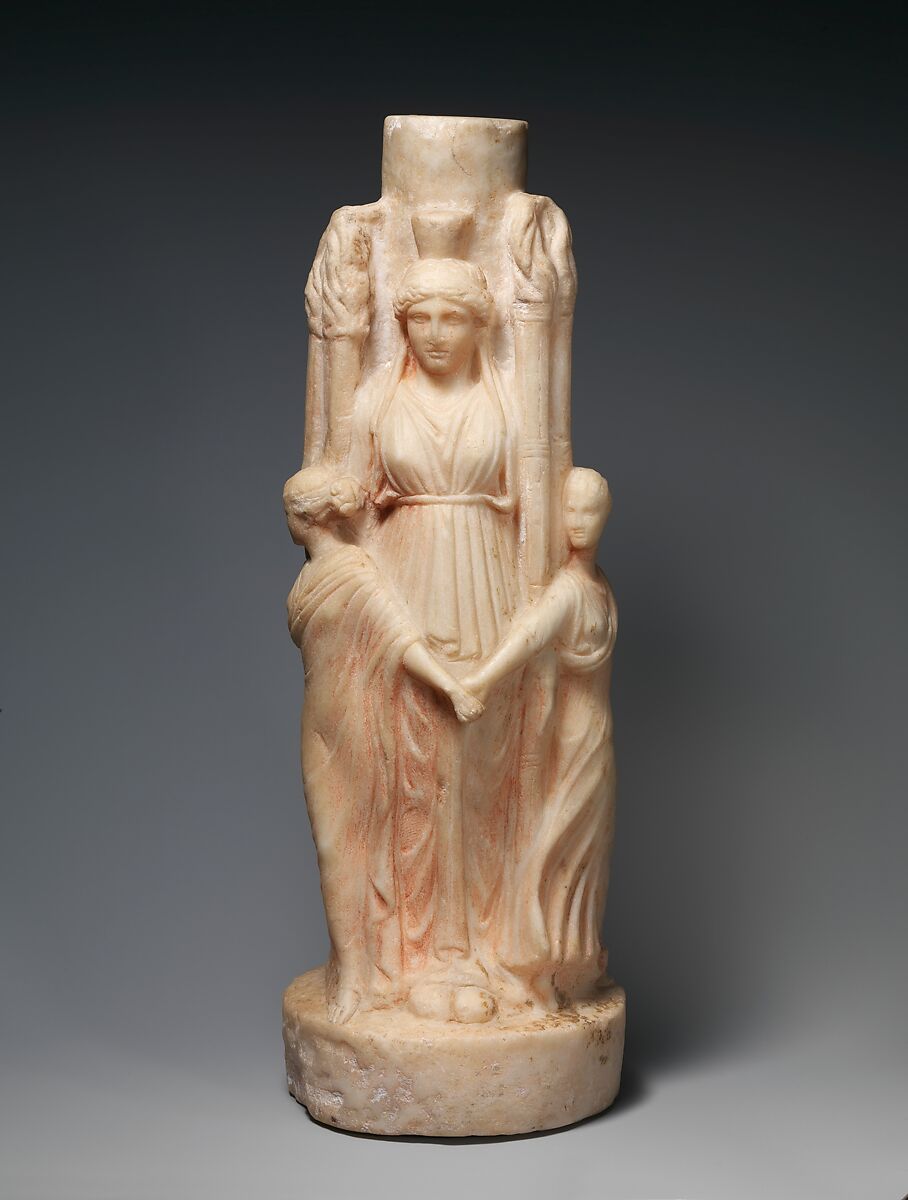
Every ancient statue of her shows young women, including the three-bodied ones. The Maiden, Mother, Crone idea was popularized by the poet Robert Graves in 1948.
INVENTION
“She always had three bodies.”
Her earliest images have one body. The travel writer Pausanias credits the sculptor Alkamenes, working in Athens in the late 400s BCE, with the first triple statue.
“She was a dark goddess of witchcraft from the start.”
In Hesiod she blesses kings, athletes, fishermen and herdsmen, with no magic in sight. The link to sorcery first appears about 250 years later, in Athenian plays about Medea.
INVENTION
“Hecate is a moon goddess.”
In the early hymn to Demeter she carries torches and is paired with the Sun. Poets only merged her with the moon in later Greek and Roman times.
SOURCE
“Circe and Medea were her daughters.”
Only one writer says so, and he was retelling the myth as history. Everywhere else Medea is her priestess, not her child.
“She was imported from Caria in Asia Minor.”
Her biggest temple was in Caria, but the oldest Greek evidence for her is older than the Carian evidence. Scholars still argue both sides.
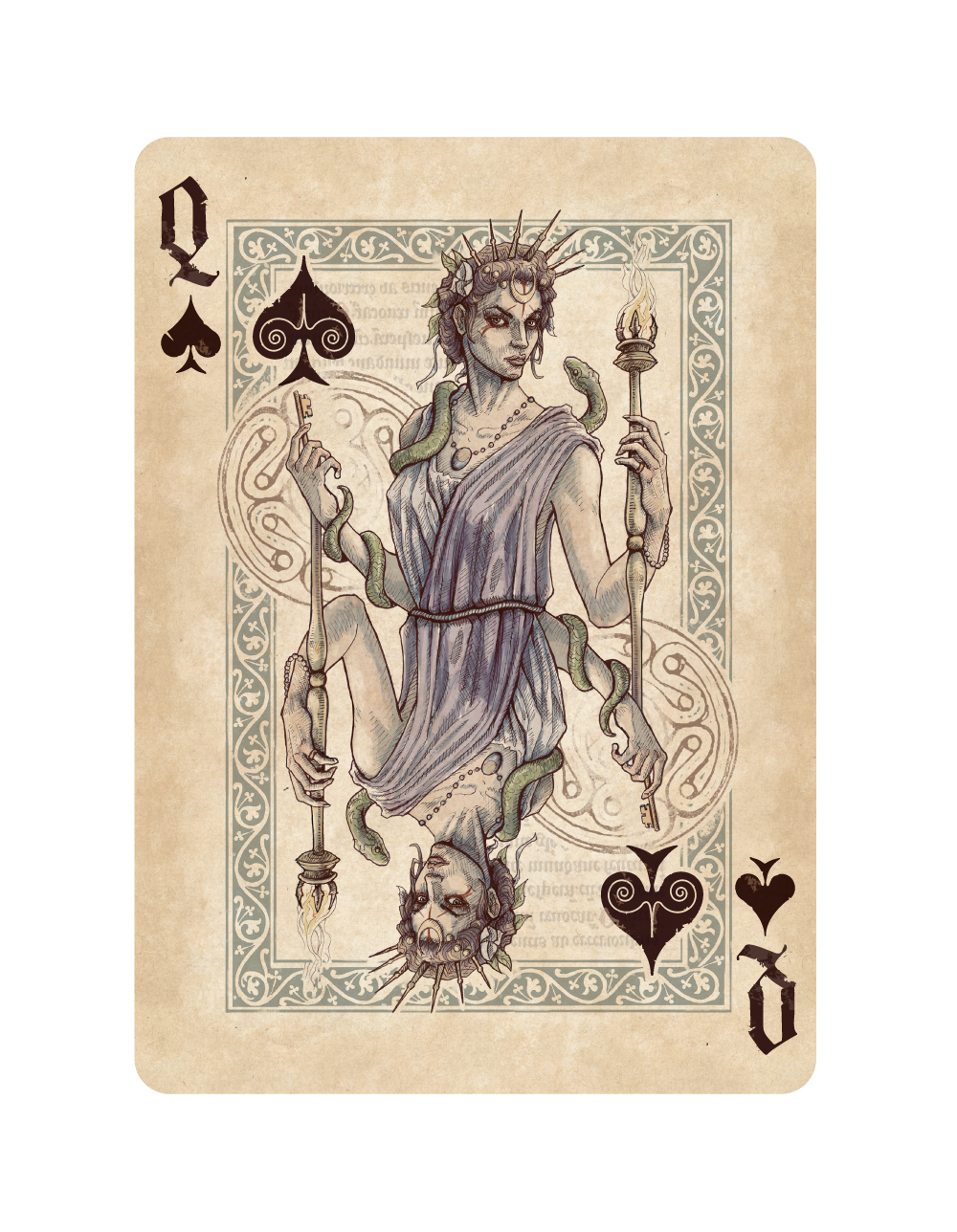
Queen of Spades
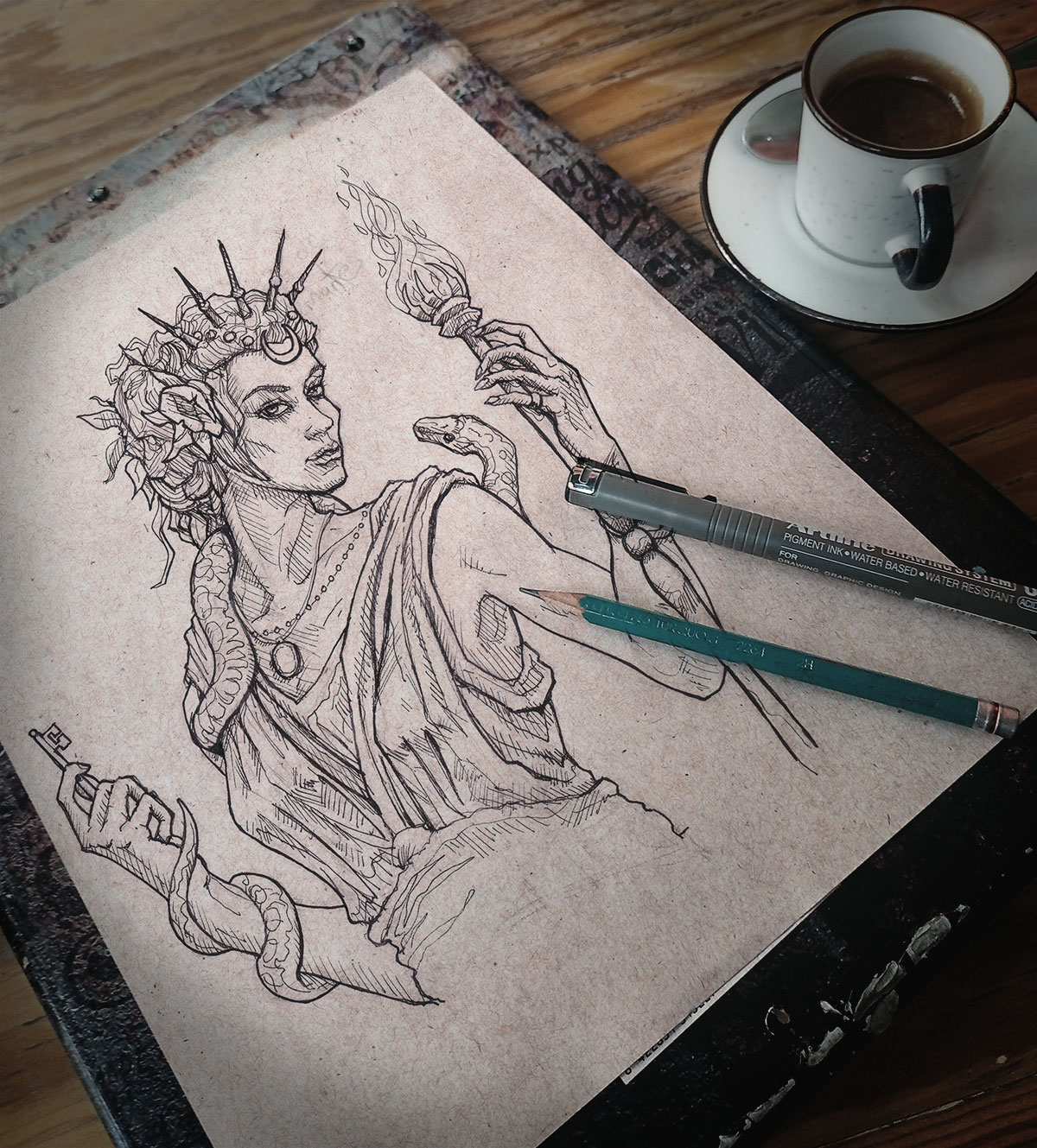
Hecate is the Queen of Spades in the Wizards, Witches & Warlocks deck from Gent Supply Co., hand-drawn by Mexico City illustrator Gustavo “Guzo” Borboa.
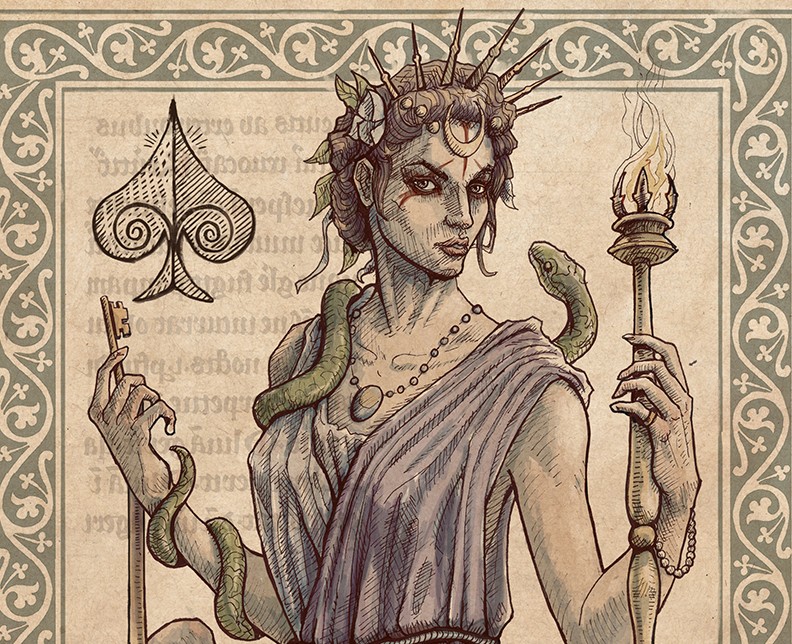
She is drawn the way the ancient sources describe her: young, crowned, a lit torch in one hand and a key in the other, with snakes coiled around her arms.
The full story
Hecate has had more makeovers than almost any figure in Greek myth. Over about a thousand years she went from a generous goddess who helped fishermen to the queen of witches, and each version left something behind. Here is how it happened, in order.
1. She starts as Zeus’s favorite
The oldest text about Hecate is Hesiod’s Theogony, written around 700 BCE. Hesiod calls her the only child of the Titans Perses and Asteria, and he clearly admires her. When Zeus took power he stripped most of the Titans of their honors. Hecate kept all of hers, with a share of the earth, the sea and the sky.
Hesiod then lists the people she helps: kings giving judgment, speakers in the assembly, soldiers, athletes, horsemen, fishermen and herdsmen. She also watches over young children. There are no ghosts in this passage, no spells and no moon. She is simply a powerful goddess who is worth having on your side.
2. The torches come from a rescue
Her next big appearance is in the Homeric Hymn to Demeter. When Hades carries off Persephone, only two gods notice: the Sun, who sees it, and Hecate, who hears the girl cry out from inside her cave. On the tenth day of Demeter’s search, Hecate comes to her with a torch in her hand and tells her what she heard.
When Persephone finally returns, Hecate embraces her and becomes her companion from then on. This one story gives Hecate two things she never loses: her torches, and her job as the goddess who can walk between the world of the living and the world below.
3. Athens puts her at the door and the crossroads
By the 400s BCE, ordinary Athenians kept a small shrine to Hecate outside the front door. The comic playwright Aristophanes mentions them as a normal part of a house. She guarded the threshold, the place where inside meets outside.
She also guarded the place where three roads meet. Once a month households carried a meal out to the crossroads and left it for her. These were known as Hecate’s suppers, and Aristophanes jokes that the poor grabbed the food as soon as it was put down. Crossroads belonged to nobody, and Greeks believed the restless dead gathered there. A goddess who could move between worlds was the natural one to keep them in line.
4. Then she gets three bodies
For her first few centuries Hecate had one body, like any other goddess. The travel writer Pausanias saw an old statue of her on the island of Aegina with one face and one body. He says the sculptor Alkamenes was the first to make her as three figures standing back to back, for a statue on the Acropolis in Athens.
The design suits a goddess of three-way crossroads, since she can face down every road at once. All three figures are the same young woman. They are not three ages of life, and none of them is old.
5. The playwrights hand her to Medea
Hecate’s link to witchcraft begins on the Athenian stage. In a lost play by Sophocles called The Root-Cutters, Medea gathers poisonous plants with a bronze sickle while the chorus prays to Hecate, crowned with oak leaves and coiling snakes. In Euripides’ Medea, the heroine swears her revenge by Hecate, the goddess she says lives at the heart of her own hearth.
Later poets turned up the horror. In the Argonautica by Apollonius of Rhodes, Jason sacrifices to her at midnight and she rises wreathed in snakes, with torches blazing and hounds howling around her. This is the Hecate most people picture today, and it is where the snakes on the card come from.
6. Rome renames her, and the moon moves in
The Romans called her Trivia, which means “of the three ways.” Roman poets blended her with Diana and with Luna, the moon. Virgil writes of threefold Hecate as the three faces of the maiden Diana, and has Dido call on the Hecate whose name is howled at city crossroads by night. The moon goddess idea comes from this period, hundreds of years after Hesiod. The Greeks already had a moon goddess, and her name was Selene.
7. Why she carries a key
Hecate’s largest temple stood at Lagina in Caria, in what is now southwest Turkey. There she was the patron of a whole city, with no witchcraft involved. Her main festival was a procession in which a girl carried the goddess’s key from the temple to the nearby city of Stratonikeia. The key marks her as the keeper of gates, including the ones between worlds.
8. Her last ancient role is savior
In the last centuries of the ancient world Hecate rose higher than ever. Spell books written in Greek in Roman Egypt call on her as a many-named power merged with the moon and with Persephone. A set of mystical verses called the Chaldean Oracles made her a cosmic go-between, standing between the highest god and the physical world. Her followers gave her the title Soteira, which means Savior.
So the goddess who ended up as the patron of witches spent most of her ancient career as a helper, a guide and a guard. The crone came much later, and from somewhere else.
SOURCES WE CHECKED
- Hesiod, Theogony 411–452
- Homeric Hymn to Demeter 24–26, 51–61, 438–440
- Aristophanes, Wasps 804 and Wealth 594–597
- Sophocles, The Root-Cutters, fragments 534–535
- Euripides, Medea 395–397
- Apollonius of Rhodes, Argonautica 3.1211–1224
- Virgil, Aeneid 4.511 and 4.609
- Pausanias, Description of Greece 2.30.2
- Diodorus Siculus, Library of History 4.45
- Deborah Boedeker, “Hecate: A Transfunctional Goddess in the Theogony?”, Transactions of the American Philological Association 113 (1983)
- William Berg, “Hecate: Greek or ‘Anatolian’?”, Numen 21 (1974)
- Sarah Iles Johnston, Hekate Soteira (Scholars Press, 1990)
- Sarah Iles Johnston, Restless Dead (University of California Press, 1999)
- Ronald Hutton, The Triumph of the Moon (Oxford University Press, 1999)
Recent Comments